 Expanager
10 best budget apps for Android in 2026, compared honestly
Since Mint shut down, there's no obvious default budget app anymore. The good ones differ in three big ways: whether they log in to your bank, whether you pay a subscription, and which budgeting method they push. Here are ten Android apps worth a look in 2026, what each costs, and who each one suits. In India? See the best expense tracker apps in India, which focuses on UPI and bank SMS.
- Best free app with no bank login: Expanager.
- Best for zero-based budgeting: YNAB.
- Best for couples and households: Monarch.
- Best for cutting subscriptions and bills: Rocket Money.
- Best free zero-based budget: EveryDollar.
- Best "how much can I spend?" view: PocketGuard.
- Best envelope system: Goodbudget.
How we compared them
- Bank linking. Most US budget apps connect to your bank through a data aggregator such as Plaid. That's convenient, but it means sharing your login and having your transactions on their servers. A few apps work without it.
- Price. Many of the best-known apps are subscription-only after a trial.
- Ads and upsells. Whether the app shows ads or sells other financial products.
- Budgeting method. Zero-based, envelopes, "safe to spend", or simple category budgets.
At a glance
| App | Bank linking | Free version | Paid price | Play rating (US) |
|---|---|---|---|---|
| Expanager | No; reads bank alerts on your phone, CSV import | Yes, no ads | $1.49/mo, $9.99/yr or $19.99 once | 4.3 |
| YNAB | Yes (or manual) | No, 34-day trial | $14.99/mo or $109/yr | 4.6 |
| Monarch | Yes | No, 7-day trial | $14.99/mo or $99.99/yr | 4.8 |
| Rocket Money | Yes | Yes, core tools | Premium on a sliding scale; Premium+ $15/mo | 4.5 |
| EveryDollar | Premium only | Yes, manual | $79.99/yr or $17.99/mo | 4.3 |
| PocketGuard | Yes (or manual) | Yes, core features | $12.99/mo or $74.99/yr | 4.4 |
| Goodbudget | Premium, US banks | Yes, 20 envelopes | $10/mo or $80/yr | 3.2 |
| Bluecoins | No; reads bank alerts | Yes, with ads | One-time Premium | 4.3 |
| Wallet | Yes | Yes | Monthly, yearly or lifetime | 4.6 |
| Money Manager | No, manual | Yes, with ads | In-app purchases $2.49–$20.99 | 4.6 |
1. Expanager: best free app with no bank login
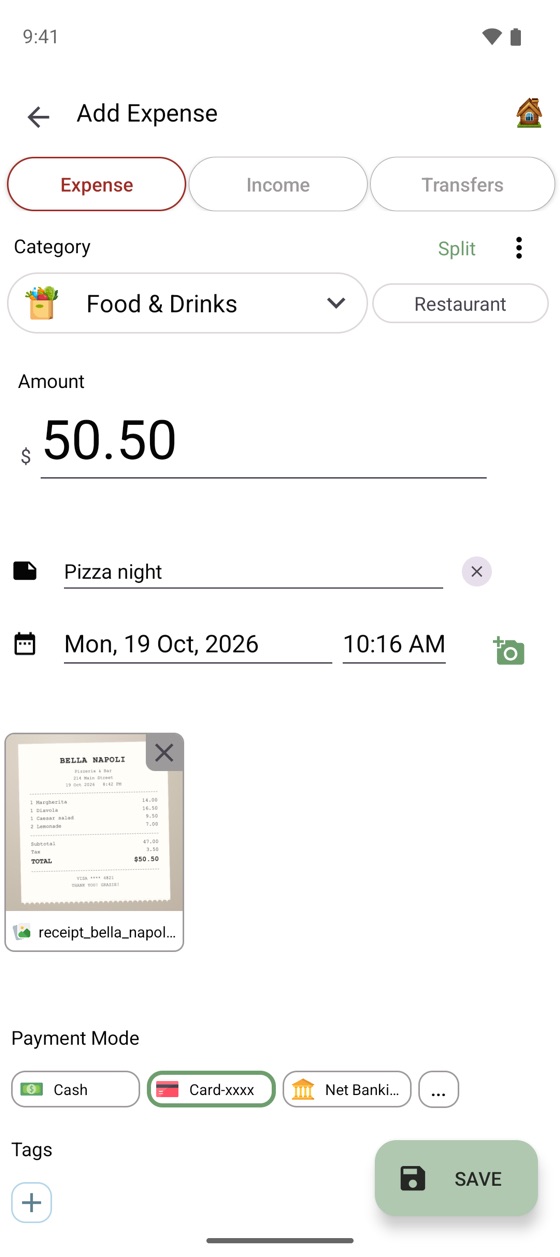
Expanager tracks your spending without ever asking for your bank login. It reads the purchase alerts your bank and card apps already send, as notifications or text messages, on your phone, and turns each into an expense you confirm with a tap. You can also import the CSV file your bank lets you download. Nothing is uploaded: there's no account, no server holding your data, no ads, and it works offline.
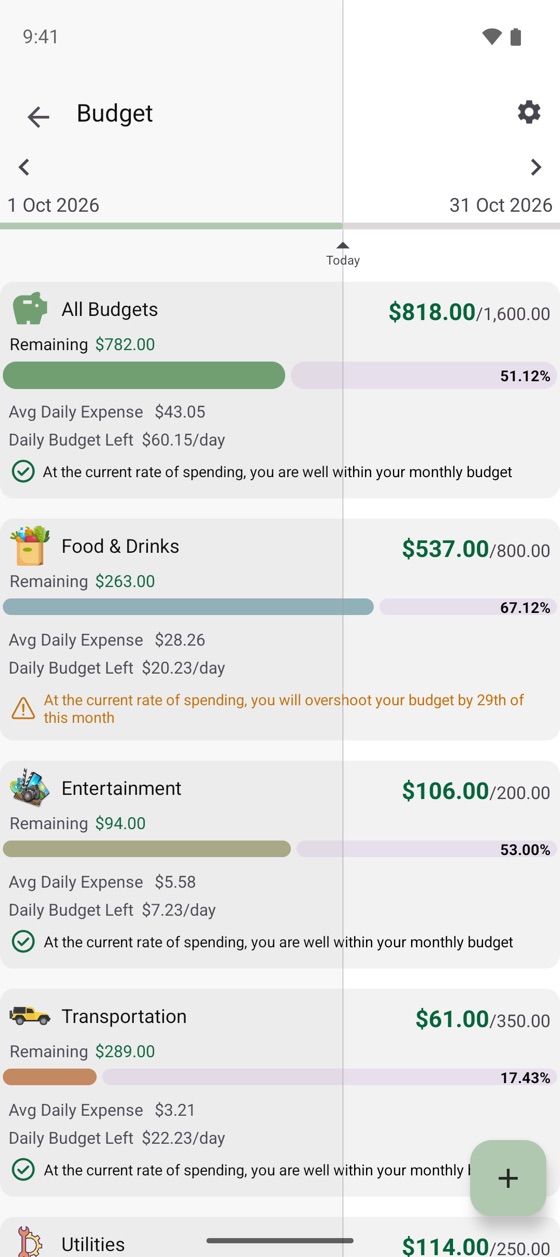
It has category budgets with a daily spending limit and early warnings, recurring bills, credit card due dates, loans, savings goals, yearly insights and PDF and Excel reports. The free version covers all of that. Premium ($1.49 a month, $9.99 a year or $19.99 once) adds Google Drive backup, multi-category budgets and statement reconciliation. How budgeting without bank linking works.
Not for you if you want balances and investments pulled in automatically, a strict budgeting method like zero-based, or an iPhone app. Expanager is Android only.
2. YNAB: best for zero-based budgeting
YNAB (You Need A Budget) is built around a method: give every dollar a job before you spend it. It links accounts through Plaid to import transactions, or you can add them manually, and one subscription covers "up to six people". YNAB says "92% of YNAB users report feeling less stressed about money". There's no free tier: a 34-day trial, then $14.99 a month or $109 a year; college students get a year free. Play US rating 4.6.
Best for people who want to change how they handle money, not just watch it, and are happy to pay for that.
3. Monarch: best for couples and households
Monarch connects your bank accounts, cards and loans, auto-categorises transactions, and lets you add a partner or other household members "at no extra cost", or invite an advisor or tax professional. It promises it will never "try to sell you another financial product you don't need", and has no ads. After a 7-day trial it costs $14.99 a month or $99.99 a year. Highest Play US rating on this list: 4.8.
Best for couples managing shared finances who want everything in one dashboard.
4. Rocket Money: best for cutting subscriptions and bills
Rocket Money links your accounts once and then helps you "find and cancel forgotten subscriptions" and negotiate lower bills on your behalf. The free plan includes subscription tracking, spend reviews and bill reminders. Premium is priced on a sliding scale; Premium+ is $15 a month. If you use bill negotiation without Premium+, it charges 35–60% of your first year's savings, and only when it saves you money. Play US rating 4.5, 10M+ downloads.
Best for finding money you're wasting on subscriptions and bills, more than day-to-day budgeting.
5. EveryDollar: best free zero-based budget
EveryDollar, from Ramsey Solutions, uses zero-based budgeting with unlimited categories, and its free version lasts "for as long as you want". The free version is manual; Premium connects your accounts to stream transactions in, exports to Excel and adds live Q&A with financial coaches, for $79.99 a year or $17.99 a month after a 14-day trial. Play US rating 4.3.
Best for Ramsey fans and anyone who wants zero-based budgeting without paying.
6. PocketGuard: best "safe to spend" view
PocketGuard's headline feature is a "safe-to-spend amount after bills, goals, and essentials", with a "Spending Pace" alert when you're going too fast. It links banks through Plaid, Finicity or Salt Edge, but also works with manual entries. Core features are free; PocketGuard Plus costs $12.99 a month or $74.99 a year after a 7-day trial and adds a debt payoff plan and bill negotiation. Play US rating 4.4.
Best for people who just want one number: how much they can spend today.
7. Goodbudget: best envelope system
Goodbudget is "a virtual update on your grandma's envelope system", shared across Android, iPhone and the web, which makes it popular with couples. The free plan gives 20 envelopes, one account and two devices; Premium ($10 a month or $80 a year) adds unlimited envelopes and automatic bank sync for US banks. Entry is otherwise manual. Its Play US rating is lower than others here, at 3.2.
Best for envelope budgeters, especially couples on different phones.
8. Bluecoins: best for detailed analysis without bank linking
Like Expanager, Bluecoins avoids bank logins: it reads banking app notifications and SMS to create transactions, keeps data on your device and backs up to your own cloud storage. It goes further on analysis, with net worth, cash flow and future projections, and reconciliation against statements. The free version has ads; Premium is a one-time purchase, "never a subscription". Play US rating 4.3.
Best for detail-oriented users who want accounting-style reports and privacy.
9. Wallet by BudgetBakers: best for travel and many currencies
Wallet syncs bank accounts automatically, imports from banks or spreadsheets, and shines for "expats, international students and travelers" with multi-currency accounts and "worldwide bank coverage". You can share selected accounts with family. Premium comes as monthly, yearly or lifetime plans, priced in the app. Play US rating 4.6, 10M+ downloads.
Best for people with money in more than one country.
10. Money Manager (Realbyte): best for manual bookkeepers
Money Manager uses double-entry bookkeeping, tracks card balances and payments, and is popular worldwide (10M+ downloads, 4.6 in the US). Entry is manual. The free version shows ads and is limited to 15 assets; paid upgrades ($2.49–$20.99) remove the ads and limit and add editing on a PC. Full comparison with Expanager.
Best for people who enjoy entering and reconciling every transaction themselves.
Not on this list, and why
- Mint was shut down by Intuit in 2024 and is no longer on Google Play. Intuit moved its users to Credit Karma, whose Play listing covers spending tracking and categorisation but doesn't mention budgets, and which shows ads and offers credit cards and loans.
- Copilot Money is only for iPhone, iPad, Mac and the web, according to its own FAQ. There's no Android app.
- Empower (formerly Personal Capital) is a net worth and retirement planning tool rather than a budget app, and its Play US rating is 2.7.
Which one should you pick?
- You don't want to share your bank login: Expanager or Bluecoins.
- You want to change your money habits and will pay for it: YNAB.
- You budget with a partner: Monarch, or Goodbudget on a tighter budget.
- You suspect you're overpaying for subscriptions: Rocket Money.
- You want zero-based budgeting for free: EveryDollar.
Frequently asked questions
What is the best free budget app for Android?
For a free app with no ads and no bank login, Expanager. EveryDollar has a free manual version, PocketGuard's core features are free, and Goodbudget is free for up to 20 envelopes. YNAB and Monarch have no free tier after their trials.
What replaced Mint?
Intuit shut Mint down in 2024 and moved its users to Credit Karma. Credit Karma's Play listing covers spending tracking and categorisation but doesn't mention budgets, so many former Mint users moved to apps like YNAB, Monarch, Rocket Money or EveryDollar.
Is there a budget app that doesn't link to my bank account?
Yes. Expanager and Bluecoins never ask for your bank login; both can read your bank's alert notifications and text messages on your phone instead. EveryDollar's free version and PocketGuard can also be used with manual entries.
Is Copilot Money on Android?
No. Copilot's own FAQ describes it as an app for iPhone, iPad, Mac and the web, and it has no Google Play listing.
Budget without the bank login.
Expanager is free on Google Play. No ads, no account.
